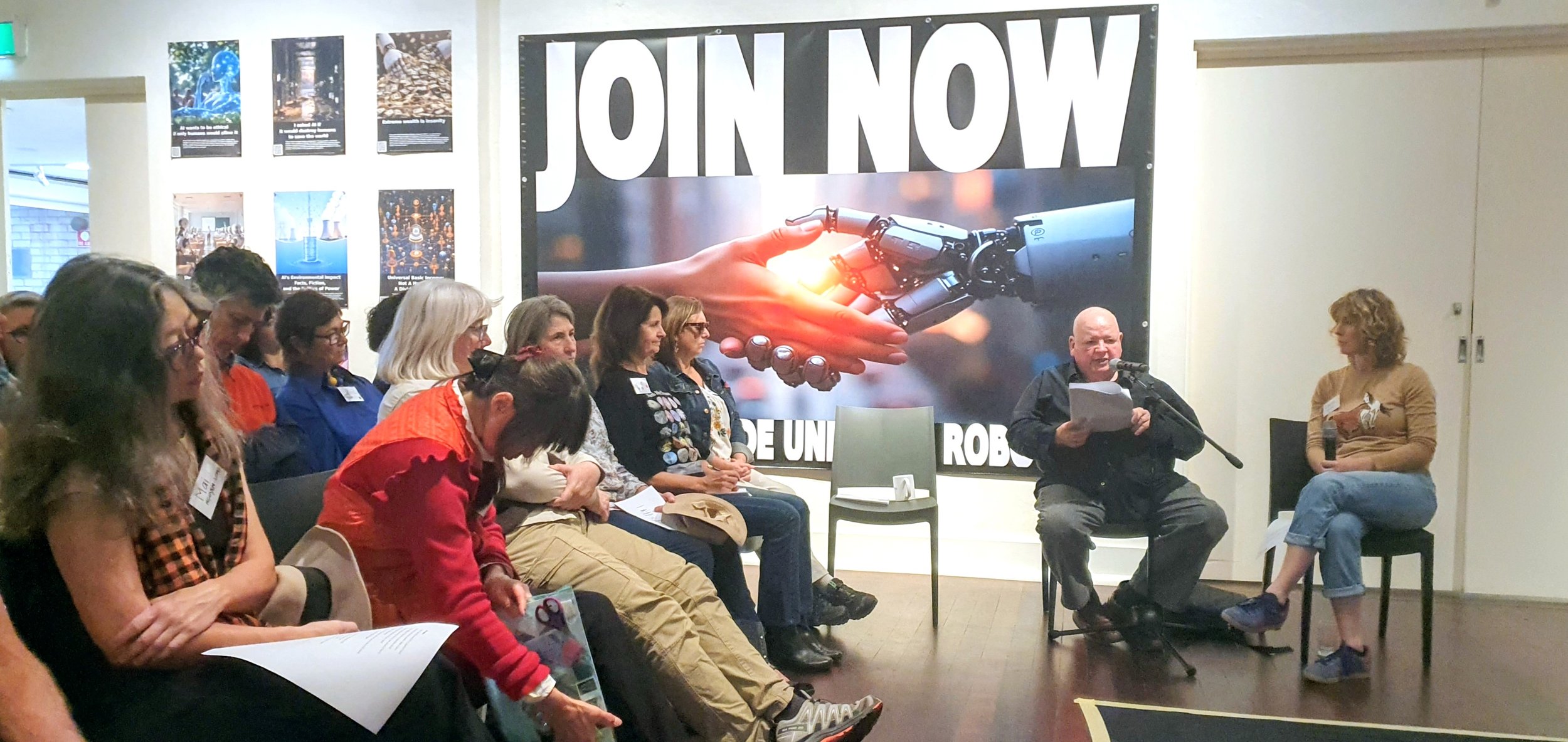
Ian Milliss presenting at Manly Art Gallery & Museum, May 2026.
At the CEAD (Collective for Environmental Art and Design) Forum held at Manly Art Gallery and Museum in May 2026, KSCA member Ian Milliss delivered a speech entitled “On what it means to be an artist now”.
Ian has posted it on his blog, and we share it here in the spirit of wide readership. For decades, Ian’s thinking and art practice has opened the doors to new ways of thinking about how art should be made, and what should be considered as the work of art. Read on…
On What It Means to Be an Artist Now, by Ian Milliss
When people ask about the future cultural directions of the world, they usually mean one of two things: what new styles the culture industry will package for us next, or how to keep existing institutions looking relevant while everything else burns.
I am not very interested in either question. The real question is much rougher: what kinds of cultural practice help people understand the world they are actually in, and help them adapt to it without becoming more obedient, more isolated, and more stupid?
So what you are going to get is not much prediction. I learned long ago that you cannot predict the direction of cultural movements because their apparent forward movement will always be sideswiped and mangled by something you barely saw coming out of the corner of your eye.
You could say my entire generation was sideswiped by climate change and many still have not fully absorbed the likely destruction of human civilisation as we know it. That is the frame everything I will say sits within.
Rather than prediction, this talk is more like Robinson Crusoe or Moby Dick: a way of grappling with a complex, uneven reality by assembling lists, fragments, examples, and working propositions. You will be getting a lot of lists!
But the parts of the argument are simple enough. For starters the future of culture will not be led by the official art world. It will be shaped by breakdown, mutual aid, ecological pressure, open-source improvisation, migration, anger, and the practical intelligence of communities forced to invent new ways of living.
For a long time I’ve argued, to the irritation of many perfectly nice people, that art in the grand institutional sense is mostly a business category. There is a business called art. There are markets, career paths, rituals of validation, mythologies of genius, collectors converting money into prestige, museums converting prestige into tourism, universities converting debt into aspiration. But the really significant cultural activity, the activity that changes how people see and think and act, has always had a much wider field. It happens in social movements, in technical improvisations, in local publications, in organising traditions, in farming experiments, in vernacular media, in open-source collaboration, in communities trying to solve actual problems under pressure.
If that sounds too political, that is because culture has always been political whenever it mattered. It changes how people see, what they value, what they believe is possible, and therefore what they are prepared to organise for. Culture is upstream of politics — not because it is superior to politics, but because politics cannot move very far without a shift in perception and desire.
The Commons and Its Destruction
And here I want to bring in something that may seem distant but in fact is the very core.
Peter Linebaugh spent decades tracing the history of the commons and their destruction. In precapitalist England a person could gather wood from the forest for fuel and shelter, graze cattle on common pasture, glean fields after harvest.
These were customary rights, built into the fabric of daily life. Their destruction through enclosure, criminalisation, and violence was the precondition for capitalism.
The point of enclosure was not just to transfer property. It was to remove people’s means of subsistence and force them into wage labour.
Linebaugh makes a crucial point about what the commons actually was. It was not only natural resources. Elinor Ostrom who in 2009 was the first woman to win the Nobel Prize for Economic Science, demonstrated the same thing from another direction. Her work on commons showed that despite right wing glorification of personal greed, people are quite capable of managing shared resources collectively without either private ownership or heavy-handed external control, provided they have rules, relationships, accountability and local knowledge.
In other words, commoning is not a relic. It is a practical human capacity. It is a way of working together. The word itself comes from obligations held in common, from what we owe each other rather than what we own.
The Enclosure of the Cultural Commons
Now think about what happened to culture. The art world underwent its own enclosure. What was once a commons of shared human creative capacity — making things, telling stories, singing songs, decorating spaces, organising rituals, passing on skills — was enclosed by institutions, markets, and credential systems. It was turned into a private property regime.
You need a degree to call yourself an artist. You need a gallery to show your work. You need a critic to validate it. You need a collector to pay for it. You need a museum to consecrate it. Each enclosure created another gatekeeper, another toll booth between human imagination and its social use.
Dave Graeber understood this very clearly. In his Debt:The First 5000 Years and elsewhere he argued that baseline communism — the ordinary assumption that people cooperate, share, and help one another as a matter of course — is not some impossible ideal but the actual substrate of everyday life.
Every time you lend a hand without calculating an exchange rate, every time you teach someone something because they need to know it, every time you cook for others, repair something together, or pass on a skill, you are acting on principles prior to the market. Capitalism did not invent cooperation. It enclosed it, monetised it, and then pretended it had created it.
That is exactly what happened to culture. Shared creative capacity became a commodity and then we were told the commodity was the real thing. We were told that art happens in galleries, music happens in concert halls, knowledge happens in universities. To add insult to injury, corporate propaganda and the most insipid and meaningless corporate slop was then branded as “popular culture”, exactly what it is not, it is in fact corporate culture. Everything else is despised as amateurism, folklore, hobby or background noise, yet the background noise is where most culture actually lives.
The Art World as Bureaucracy
So here is the thing I have been saying in one form or another for fifty years: the official culture sector is no longer the main site of cultural invention. At best it is a lagging indicator. At worst it is a laundering and extractive mechanism. It takes social conflict, ecological grief, and political urgency, turns them into manageable content, and sells them back as enlightened experience. It has become extremely good at the cosplay of radicalism. It can host the aesthetics of dissent while remaining structurally tied to property, tourism, extraction and elite reassurance.
That does not mean nothing good happens in institutions. Obviously it does – look round you here. But institutions now mostly try to control, sanitise, neuter, package and absorb energies generated elsewhere.
The real adaptive intelligence of culture is leaking out through communities, collectives, informal networks, practical collaborations, and people who would never think to call themselves artists. I have said before that the real artists may be innovative farmers, union organisers, media tacticians, archivists, neighbourhood repairers, and people who use communication creatively to produce actual change. I still think that. In fact I think it is truer now than when I first said it.
Graeber’s work on bureaucracy makes a complementary point. Administrative systems are not merely inefficient. They are often designed to suppress initiative and fragment responsibility. The art world is one such bureaucracy. It manages creativity rather than enabling it. It produces careers rather than culture. It rewards compliance rather than invention. It is a machine for selecting which forms of expression can circulate safely without threatening the underlying property relations.
But what is replacing the art world’s vacuous simulacrum of culture is not one triumphant new movement. It is a messy field of distributed cultural adaptation: mutual aid networks, community media, autonomous education, First Nations ecological knowledge, open publishing, co-operatives, regenerative agriculture, local archives, repair cultures, neighbourhood kitchens, tenant organising, solidarity economies, and experiments in living that begin as necessity and become intelligence.
This is not nostalgia for the 1970s. The conditions are much worse now. Climate breakdown, forced migration, platform capitalism, authoritarian drift, and the general exhaustion of neoliberal legitimacy are forcing a broader rediscovery of things that should never have been abandoned.
Climate Change as Crime Against the Commons
We also need to be quite hard-headed about climate change here. Climate change is not just an unfortunate side effect of modernity. It is a crime against the commons. The air is a commons. The oceans are a commons. Watersheds, soils, forests, stable seasons, biodiversity, the conditions that make agriculture possible, the metabolic exchanges between species — all of these are common inheritances that no corporation created and no state has the moral right to destroy.
Fossil capital has treated the atmosphere as an open sewer and then called the resulting catastrophe development. That is not just bad policy. It is systematic theft from the present, from the future, and from every other form of life with whom we share the world.
Once you see climate change that way, culture starts to look different too. It is not there to decorate the emergency. It is there to help us understand what has been stolen, what must be defended, and what new forms of life have to be built in the ruins.
Collaboration as Survival Strategy
And this is where collaboration comes in. Collaboration is not a technique. It is a necessity.
I want to be pointed about this. Collaboration is not a nice add-on to artistic practice. It is not a funding criterion to be ticked off. It is not a workshop you attend. Under present conditions, collaboration is a survival strategy.
The problems we face — ecological collapse, social fragmentation, housing stress, the enclosure of every remaining commons by platform capitalism — are too large, too complex, and too urgent for individual heroic production. The fantasy of the lone genius artist is not merely historically false. It is politically disabling. It models a way of being fundamentally incapable of responding to collective crisis.
A few weeks back an old friend of mine, Graham Pitts, died. Graham was a playwright, author and community cultural worker. He was legendary as one of the founders of Sidetrack Theatre and his plays had reputedly been among the most seen Australian plays ever, yet barely registered by the middle class theatre audience. And he had been actively involved in the East Timor issue.
The Timorese Association of Victoria, marking his passing, put this more clearly than most art writing ever manages. They said he did not arrive as a saviour. He arrived as a collaborator. He sat with people, listened to memories of mountains and massacres, and asked what story wanted to be told there. The important thing is not the sentimentality of that wording but the shift of agency it describes. He did not arrive with content. He helped create conditions in which collective voice could become legible. What Graham did, the tribute said, was radical: “he introduced us not as victims, but as artists.” And then this: “He understood that art is not a gift bestowed from above, but a door held open from within.”
That is what collaboration looks like when it is real — not a panel discussion, not a curated conversation, not a token consultation, but an actual redistribution of creative agency. The future cultural worker looks less like a solitary genius and more like a useful person in a complicated group. Someone who can listen, connect, visualise, communicate, map systems, build trust, circulate knowledge, analyse media, and help groups act more intelligently.
That may sound less glamorous than the old mythology, but it is far more demanding. It also means something many artists still hate hearing: anonymity may not be a failure. Embeddedness may not be a failure. Practical usefulness may not be a failure. If you work seriously with audiences outside the minute art world, you often sacrifice the comfort of elevated identity. But that identity was always dubious. If your work only matters when a gatekeeper says it matters, it probably does not matter enough.
And there is a second reason collaboration matters. It prefigures the kinds of society we will need. You do not solve climate breakdown, housing collapse, energy transition, food insecurity, or democratic decay by producing more branded individual posturing. You solve them, if they can be solved at all, by learning how to coordinate, share, maintain, argue, and build with people unlike yourself. Collaboration is not a style. It is rehearsal for survival.
Rebuilding the Commons
So here is the political programme, if you want one. We must protect and recreate the Commons, of every sort. We need to stop defending culture as a sector and start rebuilding it as a commons. And we need to recognise maintenance and repair as the equal of innovation.
Rebuilding the commons means something concrete. It means open tools, shared archives, community-controlled media, free publishing, data access, technical literacy, local memory, and the means to produce and circulate knowledge without asking permission from either the market or the bureaucracy.
It means treating the means of cultural production the way commoners treated the forest — as something shared, maintained collectively, and held in trust. It means fighting the new enclosures — platform enclosures, data enclosures, credential enclosures, copyright, landlordism in both physical and digital space — with the same ferocity that people once resisted hedges, fences and eviction.
It also means reclaiming older commons that have been stolen in more recent decades. Public ownership matters here. Not as a dreary bureaucratic fetish, but because some infrastructures should never have been turned into extraction machines. Water, energy, public transport, housing, communication systems, libraries, archives, education, health, and key digital infrastructures are too important to be left to private monopolies organised around shareholder return.
Reversing privatisation is not nostalgia. It is climate policy. It is cultural policy. It is democratic policy. A privatised grid will not plan a just energy transition. A privatised housing system will not produce stable communities. A privatised media system will not sustain an informed public. A privatised internet will not protect a commons of knowledge.
We have spent forty years being told that private ownership is efficient and public provision is obsolete. What we actually got was asset stripping, degraded service, higher prices, diminished accountability, and a social imagination trained to expect less from collective life. The ideological triumph of privatisation was not just economic. It taught people to think of everything as a personal consumer choice rather than a shared condition. That is why rebuilding the commons is also a cultural struggle. We have to recover not only institutions but habits of mutual expectation.
Enclosure was never just about land. It was about destroying a way of life — a way of working together, negotiating conflict, managing limits, and reproducing community without permanent subordination to outside authority. The enclosure of the cultural commons has done exactly the same thing. It has destroyed collective confidence in our own creative capacity and replaced it with a market for individual publicity.
The alternative is not some impossible utopia. It is already visible in every workshop, kitchen, library, union office, tool shed, garden, local server, pirate archive, community radio station, and informal school where people share resources and knowledge because life would otherwise become unliveable. The task is not to invent the commons from scratch. The task is to recognise, defend, extend, and federate the commons that already exist inside the ruins of the old order.
Repair Culture and Heritage
This brings me to repair culture, because I think it is one of the most undervalued cultural forms of our time. For years I have had the URL repairculture.com sitting there as a project I never quite managed to do anything with. It kept nagging at me because I increasingly felt that repair and maintenance were not peripheral matters but central ones.
During COVID, while writing about the artist Mierle Laderman Ukeles and her long involvement with New York sanitation workers, that intuition sharpened. Ukeles understood something the avant-garde mostly refused to understand: that maintenance is not the opposite of culture. It is one of culture’s deepest forms.
Modern capitalism celebrates innovation because innovation can be branded, patented, hyped and sold. Maintenance is much less photogenic. It is repetitive, collective, often feminised, often badly paid or unpaid, and generally invisible until it stops. But this is exactly why it matters so much. Maintenance is what keeps life going. Repair is what interrupts the logic of disposal. In a society trained to worship novelty, repair becomes a quiet insurrection.
And in climate terms it is far more than symbolic. Repair is a direct material response to extraction. Every object repaired is one less object manufactured, shipped, marketed, purchased and discarded. Every building maintained is one less building needlessly demolished and rebuilt at enormous ecological cost. Every skill of mending, patching, conserving, retrofitting and adaptive reuse is a practical refusal of the carbon logic of planned obsolescence. Repair culture says that value is not exhausted at the point of sale. It says that continuity, care, durability and stewardship are forms of intelligence.
That is also why heritage needs to be rescued from the heritage industry. Heritage is not simply a collection of beautiful old objects or officially approved monuments. Heritage is a living set of practices by which communities remember, maintain, rework and transmit what matters to them. It includes buildings, certainly, but also songs, craft skills, local knowledge, rituals, ways of growing food, stories about place, and ways of repairing damage without surrendering to amnesia.
If heritage is reduced to tourism branding or frozen reverence, it becomes useless. But if heritage is understood as a living cultural activity, it becomes part of adaptation.
A maintained building is not just a conserved artifact. It is embodied carbon not wasted. It is social memory still inhabitable. It is material evidence that demolition and replacement are not the only model of progress. A repaired tool, a restored hall, a community-run archive, a revegetated creek line, an oral history project, an old rail corridor kept public rather than sold off — these are all forms of heritage work. They are also climate work. They enlarge competence. They deepen attachment. They teach continuity across generations.
This matters because the dominant development model is one of perpetual erasure. Knock it down. Build again. Upgrade by replacement. Extract, consume, discard. That same logic has governed people as well as objects: casualise the worker, demolish the neighbourhood, privatise the utility, digitise the memory, call it innovation. Repair culture pushes in the opposite direction. It asks what can be kept going, what can be cared for, what should remain public, what can be adapted without being obliterated. It asks whether a society can become adult enough to value maintenance as highly as spectacle.
I would go further. In the next decades, the politics of repair will become inseparable from the politics of survival. Communities that know how to maintain water systems, buildings, local archives, seed stocks, soils, machinery, public space, and relations of mutual aid will be more resilient than communities that know only how to consume services delivered from elsewhere. Repair culture is not quaint. It is civilisational infrastructure.
AI and the New Enclosure
All of this becomes even more pressing in relation to AI. We are watching another enclosure battle happen in real time. AI could become part of a new commons, or it could become one more mechanism for concentrating power, deskilling labour, privatising knowledge, and enclosing the social intelligence on which it feeds.
The first thing to say is obvious but usually buried: AI systems are built from collective human labour and collective human culture. They are trained on languages, images, histories, archives, habits of reasoning, and immense quantities of publicly produced or socially produced material.
In other words, they are already parasitic on the commons. The question is whether that common inheritance remains common, or whether a few firms use it to build toll booths around cognition itself.
The open-source tradition suggests one possible path. If people can inspect systems, modify them, share them, and understand the provenance of their training data and code, then AI can contribute to a commons of knowledge, tools and collective problem solving. It can help communities analyse information, translate, publish, map damage, preserve archives, support accessibility, and circulate expertise more widely. Used that way, it could extend capacities that are otherwise monopolised.
But that is not the path corporate AI is taking. The dominant tendency is enclosure: proprietary models, opaque datasets, private compute, automated surveillance, synthetic scarcity, and the use of public knowledge to create private empires. This is a familiar pattern. Capitalism socialises the inputs and privatises the outputs. It takes from the commons, then invoices the commons for access to what was already ours.
So when I talk about AI as a developing commons, I do not mean naive techno-utopianism. I mean a field of struggle. It means arguing for open standards and open source models where possible, transparent training data, democratic governance, strong public digital institutions, and protections against both labour displacement and cognitive enclosure. It means libraries, schools, universities, public broadcasters, archives and local governments should not be passive customers of corporate AI. They should be active participants in building public-interest digital infrastructure.
China has grasped some parts of this in its own contradictory way through strategic open-sourcing and state coordination, while the Anglo-American model remains obsessed with enclosing everything in the desperate hope of maintaining monopoly rents. But the deeper issue is not East versus West. It is whether intelligence itself becomes a commons or a franchise.
And here again public ownership matters. If energy grids, transport networks, water systems and communication infrastructures are socially foundational, then so increasingly are the computational systems through which knowledge is accessed and organised. Leaving all of that to private firms would be like handing the public library system to landlords and then acting surprised when reading becomes expensive and stupid.
Conclusion: Culture as a Verb
Let me end with the simplest point, because after all the abstraction it is still the most important one.
Community is not a noun. It is a verb. An action. A choice.
Culture is the same. Culture is not a product, not a sector, not an industry, not a prestige badge. It is the collective, experimental, quarrelsome, generous, ongoing process by which people figure out how to live together. It is what we owe each other. It is obligation before ownership, mutuality before exchange, care before price.
If that is true, then the art world is not the future of culture. Increasingly it is the heritage industry of a collapsing idea. What is disappearing is not human inventiveness, but the fantasy that culture belongs to a specialist priesthood licensed by markets and institutions. What could emerge instead — if we fight for it — is a broader understanding of culture as the distributed process by which communities adapt, remember, repair, resist, and sometimes become worthy of survival.
That process must also include respect for other life. The commons never belonged only to humans. Rivers are not raw material. Forests are not scenery. The atmosphere is not a dump. Species are not decorative extras in an economic drama whose only serious actors are corporations and states.
Any culture adequate to climate change will have to abandon the old human supremacism that assumed the rest of life existed merely as resource. We share this world with other beings whose own forms of dwelling and continuity deserve respect. A politics of the commons that ignores that is not a politics of the commons at all.
So my proposition is this.
To the artists: stop defending your identity and start increasing your usefulness.
To the organisers: stop treating culture as decoration and treat it as your local operating system.
To the policy people: stop funding spectacle and start funding capacity, maintenance, repair, public ownership and common access.
To the technologists: stop pretending extraction is innovation and start building tools that enlarge the commons rather than fencing it.
To the heritage sector: stop embalming the past and start helping communities keep what matters alive.
And to all of us: stop asking whether culture can survive the future. The real question is whether there will be a survivable future without a far more democratic, mutual, repaired, publicly held and adaptive culture than the one we have now.
Don’t defend culture as a sector. Rebuild it as a commons.